

Faithful, Praying, and Still Anxious
Christian resilience coaching for people whose faith is real — and whose struggle is too. Home of the P2 Resilience Course.

Where do you stand right now?
Two free quizzes. A few minutes each. Results right away.
How steady are you under stress?
See where you're holding strong and where stress may be costing you the most.
Take the Resilience QuizHow is your whole life going?
Six areas of life, from meaning and relationships to health and stability. See where you're strong and where to give more care.
Take the Flourishing QuizYou're not doing it wrong
You pray. You read Scripture. You show up on Sunday and you mean every word of it.
And still there's a weight you can't set down — anxiety that won't quiet, discouragement that keeps returning, a voice that reminds you constantly of where you fall short.
I've sat with people in that exact spot for decades. Here's what I've come to believe: faith isn't what's missing.
The instruction wasn't wrong. Keep praying. Keep reading. Those things matter, and they are doing more than you can see. But you can add to them. There are practical, learnable tools for navigating life's hardest stretches — and every one you put in your hand gives you more to work with when the pressure comes.
That's what resilience is. Not toughness, and not a gift some people were issued and others denied. Resilience is the capacity to feel the full weight of something hard without being permanently undone by it. It's the difference between getting knocked down and getting knocked out.
And it can be built. That's what I teach.
“When I started the Providence Perspectives Resilience Course, anxiety and panic attacks had become a constant part of my life. Through this course, I gained practical tools, a new perspective, and the confidence to respond to those moments in healthier ways. I didn't walk away with a perfect life, but I did walk away with hope, resilience, and the reassurance that I don't have to let fear and worry control my life anymore.”
— Lauren Quinones - P2 Resilience Women's Circle ParticipantYou can't control the weather
Some seasons you don't get a vote on. The diagnosis. The layoff. The phone call at two in the morning. No amount of faith reschedules the storm, and Scripture never promised it would — it promised presence in the middle of one.
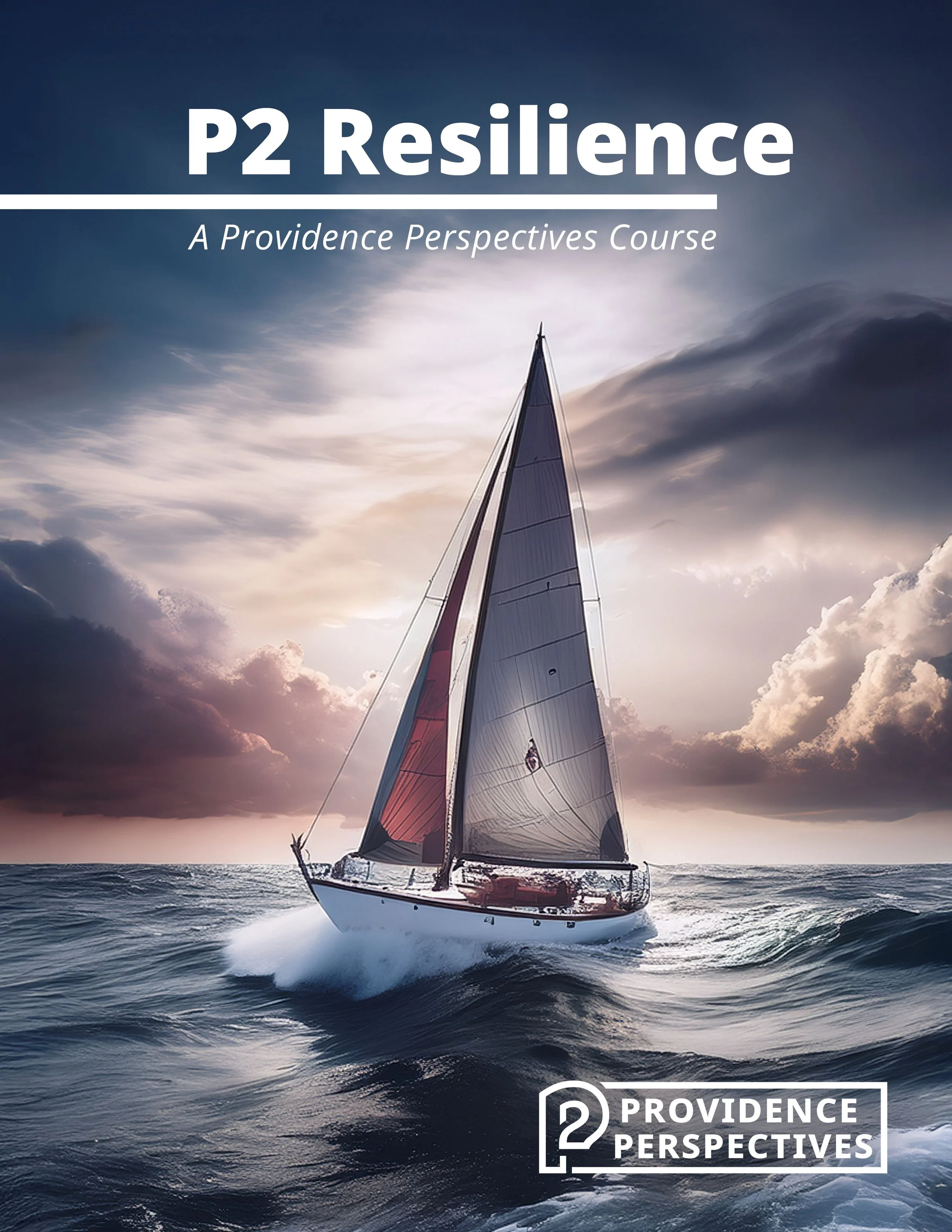
But a captain in a storm is not helpless.
There are things on that ship that answer to her hand and things that don't, and nearly all of the suffering I've watched people carry unnecessarily comes from confusing the two. So the course starts there. Four elements, because these are the four you actually control:
Attention
what you focus onAnxiety is, more than anything, an attention problem. It fixes your eyes on the wave instead of the horizon.
Thoughts
how you interpretThe same event can be a catastrophe or a setback depending on the story you tell about it. Most of us never learned we get a say.
Motivation
why you keep goingWillpower runs out somewhere around Wednesday. A reason doesn't.
Action
what you doFeelings follow movement far more often than movement follows feelings.
None of these are personality traits. Every one of them is trainable, which is the entire reason this work is worth doing.
You can't control the weather. You can control how you sail through it.
Who I work with

Most of the people who find me aren't in crisis.
They're anxious but functional. They show up, carry the load, and don't drop things. From the outside it looks like it's working.
Inside, there's a low hum of worry that never quite quiets, and a voice that's quick to point out where they fall short and slow to let them forget it. Discouraged. Overwhelmed. Not clinically depressed — just living smaller than they were made to, held back by fear and the nagging sense that they aren't enough.
This is coaching, not therapy. I'm not diagnosing or treating anyone here. If you're in a genuinely clinical season, I'll tell you honestly and help you find the right person.
I should tell you: I'm describing myself as much as anyone else.
Start by finding out where you actually stand
The Resilience Assessment measures those four things — twenty questions, about three minutes, no right answers.
You'll get a score for each element, your strongest line, your growth edge, and one thing to try this week. It's free, and you'll know more about yourself at the end of it than most people learn in a year of pushing through.
The P2 Resilience Course
P2 didn't start as a course. It started as a pattern.
For decades I sat with faithful, disciplined people doing everything they'd been taught to do, and still nowhere near the abundant life Jesus said He came to give them.
““I came that they may have life and have it abundantly.””
Different people, different circumstances, same gap. And I kept finding myself returning to the same handful of concepts. Again and again. And they kept working.
That's what P2 is. Not a framework I read about and adapted — the actual tools I've watched free people from anxiety and discouragement, across years of this work. They're also the tools I've found most helpful in my own life, which is not a coincidence.
Six sessions walk you through all four captain elements. You finish with a written resilience plan — not a certificate, not a folder of notes, but something you'll actually reach for the next time the weather turns.
It's self-paced, and it's built on a foundation of faith. It was made for a specific person: someone whose faith is genuine and who is still struggling. Those two things coexist far more often than the church tends to admit.
“Just like a Captain can decide how to sail his boat during a storm, I have the autonomy to decide how I will move through challenges in my life.”
One-on-one coaching
Some people want a guide rather than a curriculum. Individual coaching is a place to do this work with someone who knows the terrain — practical, faith-rooted, and focused on what's actually in front of you.
“While traditional counseling has been of great value to me, P2 was interactive and allowed me to truly put in the work to discover where I was struggling, clarify my values, and define the person I wanted to become.”
About Jay
I'm Jay Poland — executive pastor, coach, and founder of Providence Perspectives.
I've spent decades at the intersection of what research says about human beings and what Scripture says about them. I've also wrestled with anxiety most of my life. I'm not writing to you from the far side of this; I'm writing from inside the same work.

The Flourishing Life
A ten-part series on what a flourishing life actually requires — and why all flourishing is mutual.
“We are afflicted in every way, but not crushed; perplexed, but not driven to despair; persecuted, but not forsaken; struck down, but not destroyed.”
You can start where you are
Find your score, start the course, or just have a conversation. No pitch, no pressure.
Not crushed. Not driven to despair. Not forsaken. Not destroyed.
That's resilience, in the most honest terms I've ever read. It doesn't pretend the pressure isn't real. It insists the pressure isn't the final word.